Dates: Thursday, 9 October 2025 to Sunday, 16 November 2025, Tuesdays to Sundays 10AM – 8PM
Venue: Space63, Comuna, 238 Pablo Ocampo Sr., Ext., Makati
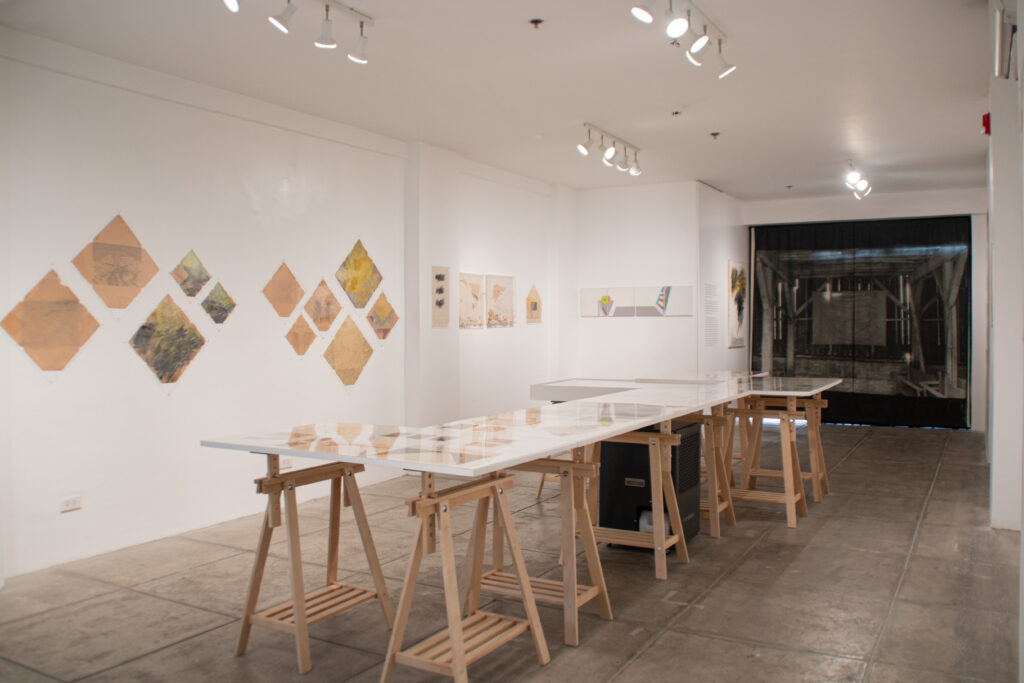
Container of Distance, the second exhibition of Filipino-Chinese artist Elisa Tan (1937–2022) in the Philippines, gives space to an artist whose remarkable practice synthesized minimalism, conceptual art, and a deeply personal meditation on language, migration, and belonging.
Despite having an extraordinary artistic journey that spanned three decades and three continents, Tan has remained largely unknown. After graduating with a degree in Fine Arts from the University of the Philippines Diliman in 1963, Tan spent a decade in the United States (1964–1974) developing her painting practice. Her artistic evolution took a decisive turn toward the conceptual after moving to Europe in 1975, as she transformed the envelope and postal material into both material and metaphor—containers carrying “the absence of one in the presence of the other.”
As a member of Paris’s Le Collectif Femmes/Art between 1976 and 1978, Tan created work that challenged traditional boundaries between image and text. Her writing performances—typing endless conjugations of verbs or filling envelopes with the word mots (“words”)—explored labor, gender, and the relationship between language and meaning. These works emptied words of conventional significance while filling them with new visual and spiritual possibilities.
Tan’s practice anticipated conceptual art’s return to materiality and personal narrative. Her innovative artist’s books, which include an edible book and copious pages filled with meticulous repetitions, transformed mundane acts into profound meditations on existence and communication.
In 1996, Tan returned to the Philippines and devoted herself to spiritual life, setting aside her art practice. This exhibition, developed through careful research of her archive in Baguio, offers the opportunity to encounter an artist whose unexplored work resonates with clarity and contemporary relevance.
It is a rare opportunity to produce an exhibition, as well as write about an artist and her practice in the mode of a first encounter, a new discovery, even as the artist herself has passed. The awe that we have at being part of Tan’s recovered “newness” exists alongside the melancholy of a posthumous recognition. It is an uneasy oscillation: the dual experience of advocate and mourner, of joy and sadness, as we share a work that arrives to us complete, fully formed, and—infuriatingly—beyond dialogue with the artist, her intentions, thoughts, and ideas. Such circumstances place a particular weight on interpretation, as custodians not only of the exhibition but of its introduction to a wider public.